
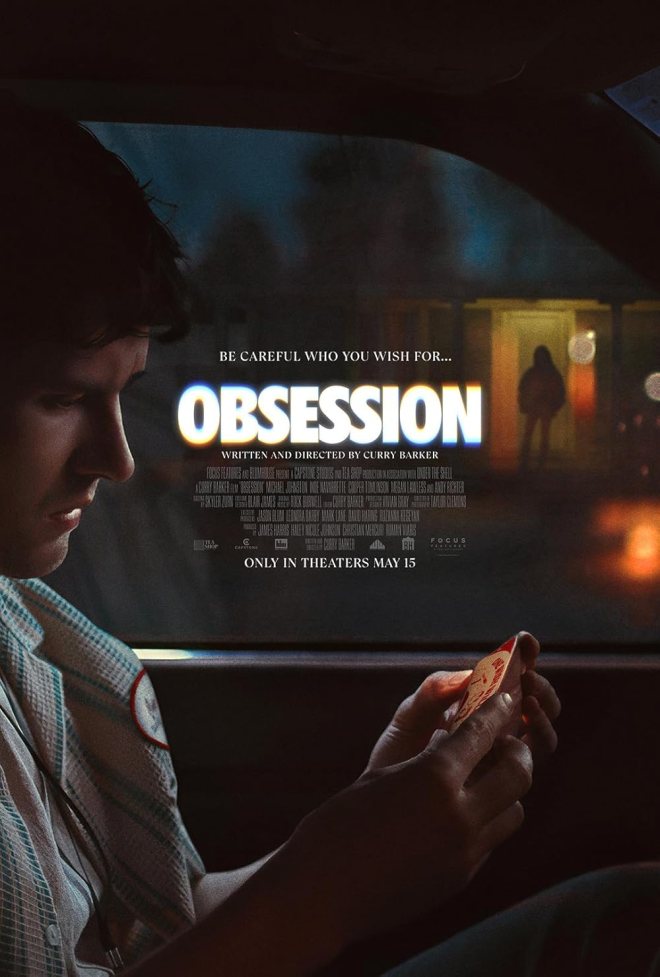
This summer, the independent A24 horror film Obsession by Curry Barker hit cinemas and immediately became an unexpected global success. The movie surrounds the young newcomer Michael Johnston, who secretly fancies one of his best friends, Nikki – played by the immensely talented Inde Navarrette – but is too afraid to tell her how he feels, which is why he ends up using a “One Wish Willow” to wish for her to “love him more than anyone in the world”. Unfortunately, his wish backfires, leading to disturbing consequences as Nikki is plagued by a demon of obsession and monstrosity.
While watching the movie, I recognised a certain type of woman in Inde Navarrette as Nikki – she reminded me of Megan Fox as Jennifer Check (Jennifer’s Body) and Florence Pugh as Alice (Don’t Worry Darling). I wasn’t scared of her; instead, I felt incredibly sorry for how her character and life turned out. She became unstable, obsessive, hysterical, destructive. She is framed as a warning and a spectacle at once, pitiable enough to watch but dangerous enough to fear.
Cinema, moreover, society as a whole, loves to ask what happens when a woman goes crazy – be it the “crazy ex” who cannot let go, the wife who “loses her mind”, the girl whose pain curdles into humiliating or horrendous actions. It is far less interested in asking who drove her there.
What makes movies like Obsession, Jennifer’s Body and Don’t Worry Darling so interesting when placed next to one another is that each film, in different ways, circles the same ugly truth: women are often denied autonomy by men who fear rejection, loss of control, or their own inadequacy. When the woman finally breaks under that pressure, she is cast as the villain.
In Obsession, the central dynamic is not simply desire, romance or betrayal. It is possession. The man at the centre of the story does not want the woman; he wants authority over her. He wants the certainty of her dependence, the comfort of her orbiting around him, because autonomy leaves open the possibility that she might choose otherwise. She might reject him. She might leave. Instead of facing that vulnerability, he would rather keep her in a state of emotional ruin, because a woman in pain is easier to manage than a woman with freedom. However, he is still willing to deceive and potentially cheat, which raises the question of whether he ever truly liked her as a person or just valued the idea of her liking him. The cruelty of this dynamic is not just that he harms her; it is that the story turns her suffering into evidence of her instability. She becomes “too much”, “unhinged”, “crazy”, while his need for domination is flattened into romance, concern or male woundedness. The woman becomes the problem, rather than the conditions that the man put her in that produced her collapse.
That pattern also runs through Jennifer’s Body, a film that was initially misunderstood as camp horror but has since been reclaimed for the brutal clarity of its gender politics. Jennifer is sacrificed by men who believe her body can be exchanged for their own success. Her humanity is irrelevant; what matters is what she can do for them. But because she is not a virgin, the ritual backfires, and she returns as a demon — hungry, angry, vengeful. In other words, she becomes a woman whose body can no longer be consumed by men without consequence. The horror of Jennifer’s Body lies not only in the blood and violence, but in the social logic beneath it: a girl is used by men, violated by men, transformed by male entitlement, and then coded as the monster. Once again, the woman bears the visible mark of violence while the men who inflicted it get to disappear behind the mythology of her madness. The brilliance of Jennifer as a figure is that she stands for what culture has always feared in women: appetite. She is not passive, grateful, pure, or wounded. She bites back, literally. And because women are still expected to metabolise pain in ways that remain attractive, quiet or morally acceptable, Jennifer’s rage is recast as evil.
Don’t Worry Darling showcases the struggle over female autonomy in a shinier universe. Here, control is not exercised through overt violence alone, but through the fantasy of domestic perfection. Alice’s husband does not simply want to be loved; he wants to curate reality itself to eliminate the possibility of her refusal. He traps her in a fabricated world because the real world contains too much uncertainty. Similar to Nikki in Obsession, she might not want him, she might not choose the life he wants, she might exist beyond his authorship – so he takes her autonomy entirely, replacing it with an artificial universe designed to keep her compliant. Predictably, when she begins to sense that something is wrong, she is treated as irrational. Her distress becomes proof of instability rather than proof that she is being mentally and physically imprisoned. The “crazy woman” narrative functions here exactly as it so often does in real life – not as a description of a woman’s state, but as a tool used to dismiss her perception.
What links all three films is simple: a woman’s loss of autonomy follows a man’s control. Her “madness” does not emerge out of nowhere; it is a response to manipulation, exploitation, coercion and violation. Yet the cultural script remains intact – she is obsessive, she is hysterical, she is dangerous: she is the problem. The man, meanwhile, is often granted complexity, sympathy, or at the very least narrative distance from the damage he has caused.
The figure of the “crazy woman” has always been politically useful. It allows male violence to be reframed as female instability. It turns trauma into temperament. It turns self-defence into overreaction. It turns the psychic consequences of control into evidence that the controlled woman was defective all along. If she is paranoid, we do not ask what made her afraid. If she is angry, we do not ask what was taken from her. If she is obsessive, we do not ask who taught her that love and suffering were inseparable. However, the most urgent question is not why women lose their minds, but why culture is so invested in narrating women’s pain as pathology while leaving male domination structurally intact? What if the point is not that these women are irrational, but that they are responding – sometimes destructively, sometimes monstrously, sometimes in ways that are difficult to redeem – to systems built to break them?
Trauma, coercion, humiliation, gaslighting, sexual violence, emotional captivity – none of these produces “perfect victims”. They produce women who survive however they can, women whose coping mechanisms might be ugly, women whose anger is loud and inconvenient, women whose behaviour can no longer be packaged into innocence. That is why these films matter. They are not just stories about women going mad; they are stories about the conditions under which women are made mad, and then blamed for what their madness looks like. They ask us to reconsider the women we have been taught to fear, mock or dismiss.
The “crazy woman” is one of culture’s oldest misogynistic archetypes because she does double duty – she punishes women for stepping outside acceptable femininity, and she absolves men of responsibility for the damage they inflict. What Obsession, Jennifer’s Body and Don’t Worry Darling reveal, intentionally or not, is that female instability is so often narrated as an individual defect when it is in fact environmental evidence. It tells us something about the world around her, about who wanted power, who feared rejection, who could not tolerate her autonomy, and who found it easier to call her mad than to confront what had been done to her.
Maybe she is not “crazy” in the simplistic way we have been trained to understand. Maybe she is traumatised. Maybe she is fighting for self-protection. Maybe she is responding to the psychic violence of being controlled, consumed, manipulated or denied personhood. Maybe the horror is not her breakdown, but the world that made it inevitable. And maybe the real villain is never the “crazy woman” but the one who benefits from making or calling her that.
Written by Vicky Madzak
 GEM Magazine